
Emergency Air Duct Cleaning Near Me: What Williamsbridge Homeowners Should Do First
If water is still leaking into your duct system when the cleaning crew shows up, the job can’t be completed correctly. That’s the part most homeowners miss. Emergency duct cleaning in Williamsbridge isn’t about how fast a crew arrives; it’s about shutting off the source of contamination first. A burst pipe above a return duct, smoke from a kitchen fire, or rodents moving through the supply lines: whatever caused the problem is still active until you stop it. Address that in the first hour, and the cleaning that follows actually holds. Skip it, and you’ll pay twice.
If you’d rather not sort through it alone, call (844) 443-3861. We answer 24/7. Fast dispatch from 7am to 7pm, Sunday through Friday.
What Actually Counts as a Duct Cleaning Emergency in Williamsbridge?
Most duct problems are maintenance issues, not emergencies. Three scenarios genuinely qualify, and each one changes what has to happen next.
Post-fire smoke infiltration. A grease fire, an electrical fire, even a small contained blaze pushes soot and smoke residue through the return side of the system. That residue doesn’t stay put. Every time the blower runs, it redistributes fine particulate through rooms that were never near the flames. In Williamsbridge homes where ductwork runs through shared interior walls, smoke travels farther than most people expect.
Flood water in the ductwork. A burst supply line, an overflowing fixture upstairs, or groundwater entering a basement air handler can leave standing water inside insulated flex duct. Wet insulation is a growth medium, and it doesn’t dry out on its own once the system is sealed back up.
Confirmed active rodent presence. Droppings in a return register are the giveaway. Rodent activity in ductwork is a contamination issue as much as an animal problem, because what they leave behind gets pulled into the living space.
- Fire or smoke residue in the air pathway
- Standing water or saturated insulation inside ducts
- Active rodent activity confirmed inside the system
Anything short of these three is usually a cleaning job to schedule, not a crisis to manage.
What Should You Do in the First 60 Minutes?
Shut the system down. That’s the first move, and it’s the one people skip. Switching off the HVAC at the thermostat and at the breaker stops the blower from pulling contaminated air through every room in the house. A running system turns a localized problem into a whole-home one.
Here’s the order that works:
- Kill power to the air handler and set the thermostat to off. Confirm the blower has actually stopped.
- Stop the water source if water is involved. Close the supply valve, or call a plumber if you can’t locate it.
- Photograph everything before you touch a thing. Waterlines on drywall, discolored registers, visible residue, the source itself. Your insurer will want a record of the conditions as they were.
- Isolate the affected zone. Close the registers in rooms with obvious contamination and keep doors shut. If the air handler is in a basement, block the doorway with a towel or plastic sheet so air doesn’t migrate upstairs.
- Don’t run fans or a shop vac near contaminated ductwork. You’ll aerosolize what you’re trying to contain.
- Call your insurer, then call a duct professional. Documentation first, service second. The paper trail matters more than people think.
That’s an hour of work, and it’s the difference between a cleaning scope and a restoration scope.
Cleaning, Replacement, or Mold Remediation? How to Tell the Difference
This distinction drives the entire cost of the job, and it’s the one homeowners get wrong most often. Cleaning removes contamination from ductwork that’s structurally sound. Replacement becomes necessary when the duct material itself is compromised. Mold remediation is a separate discipline that has to happen before or alongside cleaning.
- Cleaning fits when the duct material is intact, dry, and the contamination is surface-level: soot film, dust load, rodent residue, light debris.
- Replacement fits when insulated flex duct has been saturated and stayed wet, when sections have collapsed or separated, or when rodent damage has compromised the liner. Cleaning a wet, damaged duct is money thrown at a problem that won’t stay fixed.
- Mold remediation fits when you can see growth on duct interior surfaces or smell the musty signature after the system has run. That’s a containment and treatment job, not a vacuum job, and it usually involves coordinating with a licensed remediation contractor.
In Williamsbridge’s older housing stock, duct runs are often a mix of original galvanized metal and later flex additions. That mix means one section can be cleanable while another needs replacing. A proper scope with a camera tells you which is which. In our experience, homeowners who skip the scoping step end up paying for cleaning twice.
Why Running the HVAC While You Wait Makes It Worse
Every minute the blower runs, it moves contaminated air through the entire system. Soot, rodent particulate, mold spores, and moisture all travel the same pathway your conditioned air does. A single return register can feed every supply vent in the house, which is why smoke residue from a contained kitchen fire shows up in bedrooms at the far end of the hall.
What to do instead:
- Keep the thermostat off until a technician has scoped the system.
- Open windows in unaffected rooms for ventilation, but keep contaminated zones closed off.
- Don’t run ceiling fans, box fans, or portable air cleaners with HEPA filters sitting inside a contaminated room; they’ll load up fast and can spread fine particulate as they pull air through.
- Avoid cooking, burning candles, or anything else that adds to the particle load until the system is assessed.
It’s a strange kind of patience: doing nothing is the active choice. But sitting tight with the system off is genuinely the right move while you line up service.
What to Ask an Emergency Duct Cleaning Company Before They Arrive
Ask three things on the phone, and listen for whether the answers are specific.
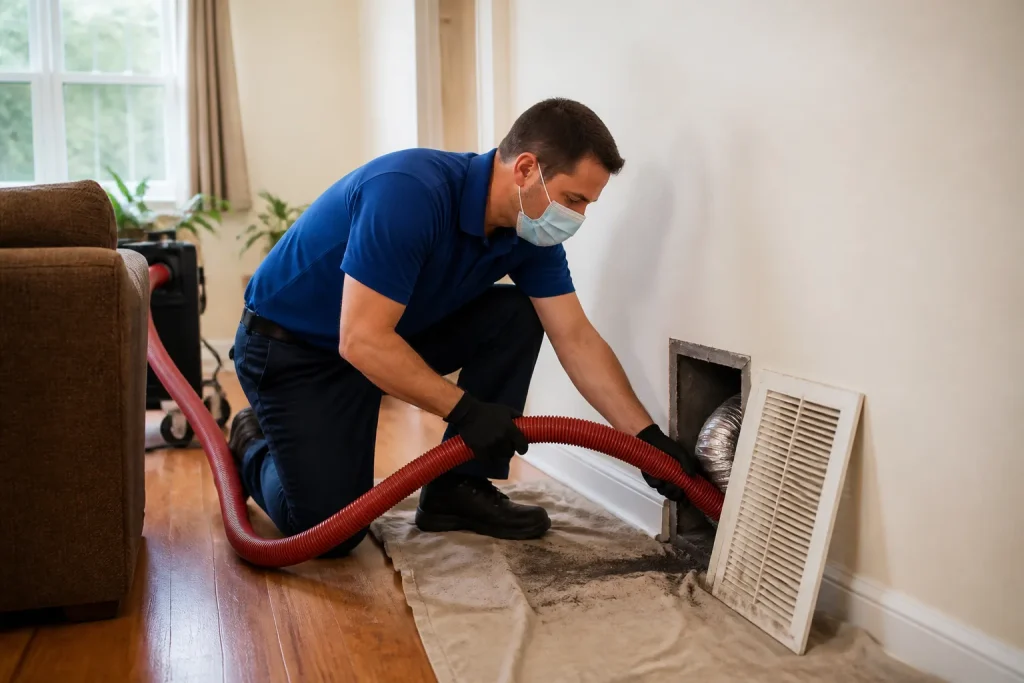
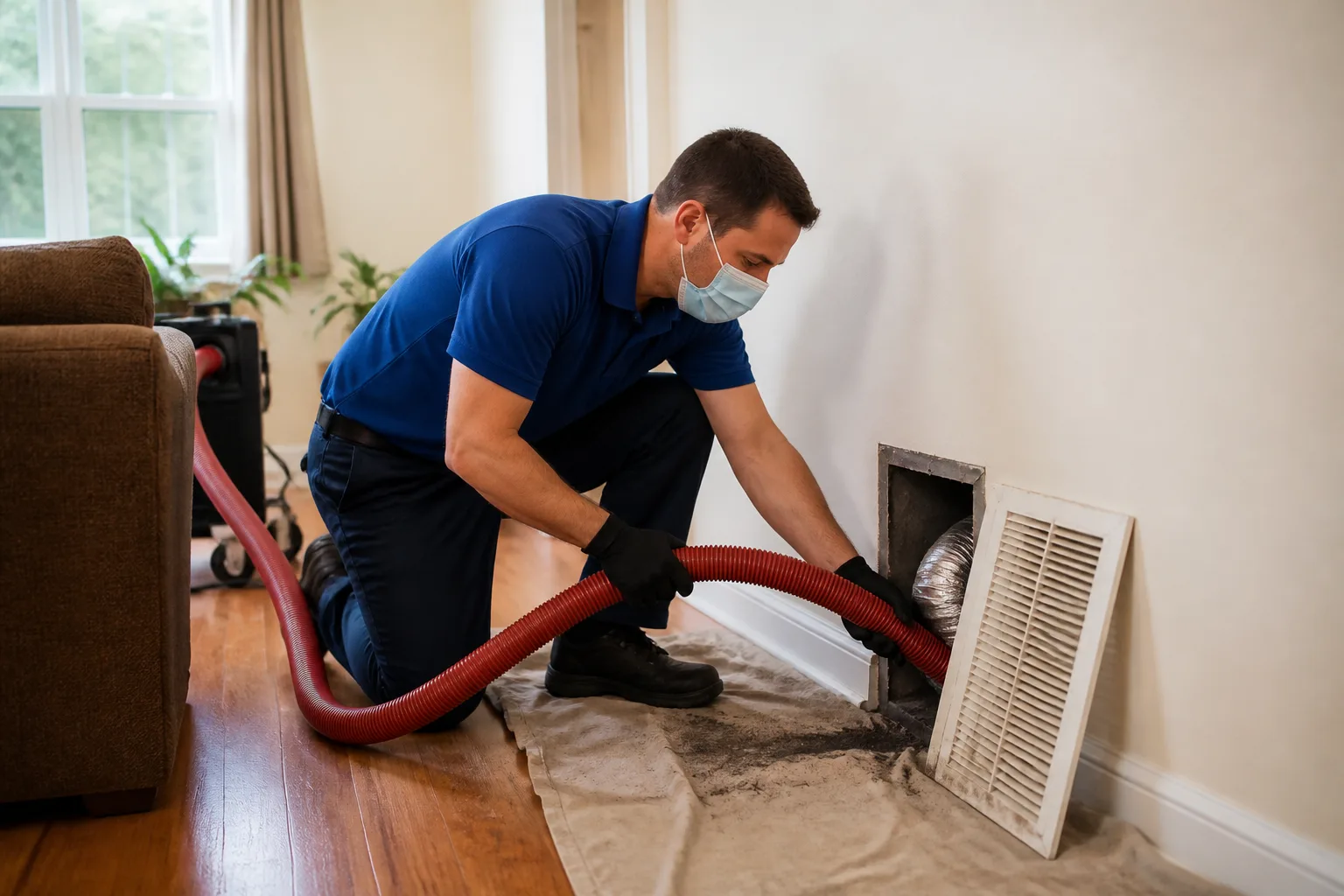
What equipment are they bringing? Consumer-grade vacuums and shop vacs don’t move enough air to clean a residential duct system properly, and they don’t capture fine soot or rodent particulate. Professional systems do. We work with Rotobrush and Nikro equipment, the same class of machinery used in restoration work, because that’s what the job actually requires. If a company can’t tell you what they’re running, that’s your answer.
Can they scope and document the system? A camera inspection before and after is the difference between “we cleaned it” and proof that they cleaned it. Before-and-after photos of your own ducts should be standard, not a favor.
Do they coordinate with restoration contractors? After a fire or flood, duct cleaning is one piece of a larger job. A company that works alongside restoration crews, and uses brands like Abatement Technologies for sanitizing, understands the sequence. One that doesn’t may clean ductwork that gets torn out a week later.
Ask about sealing too. Cleaned ducts with gaps at the joints leak air and re-contaminate. Sealing is part of the job, not an upsell.
When to Call a Pro
Call when the source is stopped and the system is compromised. If you’ve killed the power, contained the water or documented the smoke damage, and the ductwork still holds contamination, that’s the moment. Don’t wait for a smell to develop. Soot and rodent residue don’t announce themselves, and mold growth inside a sealed duct can go unnoticed for months.
A free estimate costs you nothing and tells you whether you’re looking at cleaning, repair, or replacement. One flat price per system, agreed before work starts, is what you should expect. No per-vent pricing, no surprise line items once the technician is on site.
Related services in Williamsbridge: our air duct cleaning page covers standard whole-system cleaning, and our HVAC cleaning page explains what happens to the air handler and coil after a smoke or water event. If a dryer vent was involved in the same incident, dryer vent cleaning is worth reading before you schedule anything else.
The Bottom Line
The first hour of an emergency duct situation matters more than the response time of any crew. Shut the system down, stop the source, document everything for your insurer, and isolate the contaminated zone before you pick up the phone. Then call a company that can tell you exactly what equipment they’re using and whether they’ll scope and photograph your system before and after the work.
Our technicians have up to 13 years of experience with full-system air pathway work: cleaning, sealing, HVAC, dryer vents, and sanitizing with Guardsman-grade finishing products so the system is protected, not just cleaned. We can work with your insurer on documentation, and the estimate is free.
If you’re in Williamsbridge and need help, Air Duct Cleaning Williamsbridge offers free estimates – call (844) 443-3861. We answer 24/7. Fast dispatch from 7am to 7pm, Sunday through Friday. Our full service overview lives at Air Duct Cleaning Williamsbridge.
Frequently Asked Questions
Whole-system duct cleaning is priced per system, not per vent, and the final figure depends on the size of the system, the type of contamination, and whether repair or sealing is needed. You’ll get one flat price agreed before any work begins, and the written estimate sets the final number. Call (844) 443-3861 for an exact quote – estimates are free.
Yes. Turn it off at the thermostat and at the breaker. A running blower spreads soot, moisture, and rodent particulate through every room the system serves. Keeping it off until a technician has scoped the ductwork is the single most useful thing you can do while you wait.
It comes down to the condition of the duct material and what’s growing or sitting inside it. Intact, dry ducts with surface contamination need cleaning. Saturated or damaged flex duct needs replacement. Visible growth or a persistent musty smell calls for remediation. A camera scope settles the question in minutes, and skipping that step is how people end up paying for the wrong job.
Usually because they’re quoting per vent with consumer-grade equipment, or they’re leaving out scoping, sealing, and sanitizing. A low number that becomes a much larger invoice once the technician is on site is the oldest trick in this trade. Ask what equipment they run and whether you’ll see before-and-after photos of your own ducts. Call (844) 443-3861 for an honest whole-system estimate.
We’re closed on Saturday. We answer the phone 24/7, though, so a call that comes in on Saturday gets booked into the next opening, Sunday through Friday, 7am to 7pm. Emergency work is priced the same as any other job, set by the written estimate.
Written by the team at Air Duct Cleaning Williamsbridge.
Need Air Duct Cleaning Help?
Call Air Duct Cleaning Williamsbridge - the local pro we connect you with is licensed and insured, with free written estimates in Williamsbridge.
(844) 443-3861