
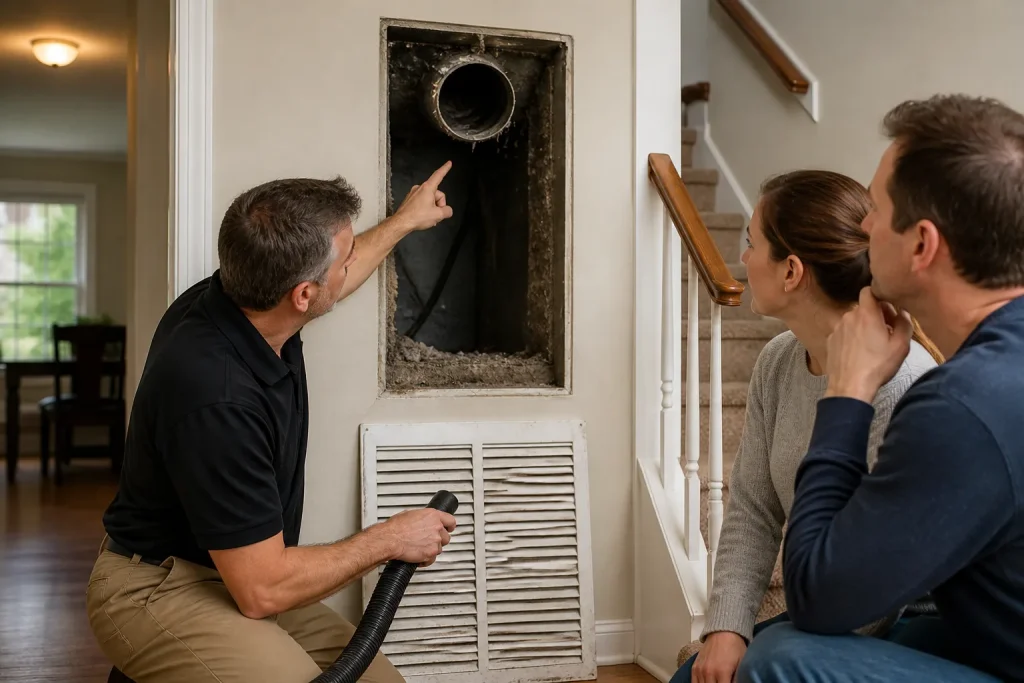
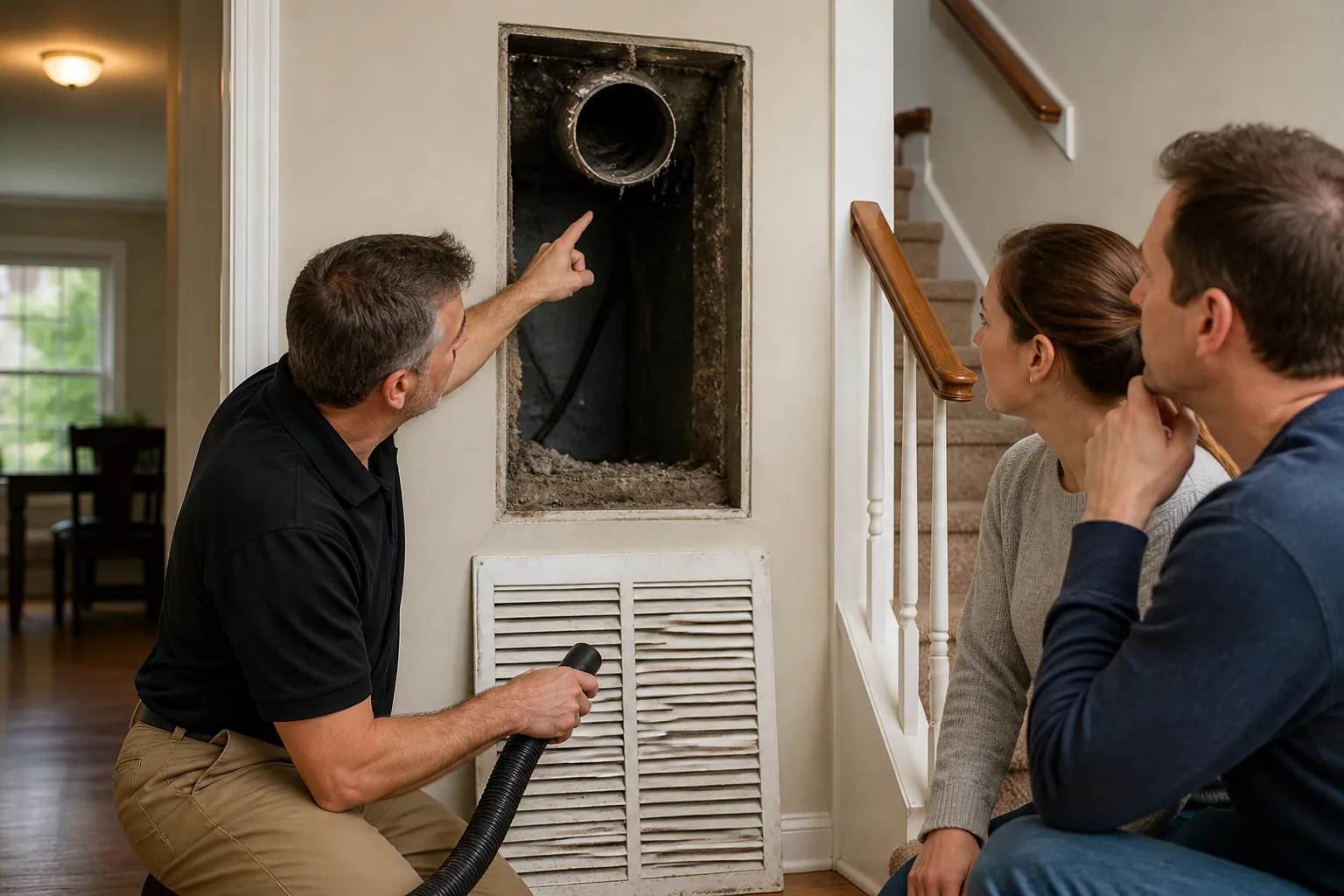
Air Duct Cleaning: Repair or Replace? How Williamsbridge Homeowners Decide
Most duct decisions start with the wrong question. Homeowners ask whether the ducts are old enough to replace, or whether cleaning costs less than new pipe. Neither question gets you very far. The real question is whether the duct layout and material can physically support the airflow your HVAC system needs. If they can’t, cleaning and sealing just makes a badly sized system look nicer. Carlines and ductwork run on the same logic: fresh paint on a cracked frame fools nobody for long, and we’ve seen plenty of Williamsbridge systems that were sealed clean while the real problem stayed put.
If you’d rather not sort through all this yourself, call (844) 443-3861 and we’ll walk you through it.
What Actually Decides It: Static Pressure, Not Age
Duct condition comes down to whether air can move through the system freely. Excessive static pressure on the air handler is the clearest signal that your ductwork is working against your equipment rather than with it. When static pressure climbs, the blower has to push harder, airflow drops, and rooms stay uneven no matter how often you change the filter.
Age tells you almost nothing on its own. A 1970s duct system with straight, well-sealed trunk lines can outperform a much newer one choked by crushed flex runs. In our experience around Williamsbridge, the determining factors are usually these:
- Available static pressure headroom. Modern HVAC units are tuned to tighter pressure budgets than older ones. Ductwork from an earlier era often eats that budget before the blower gets going.
- Duct material and internal surface. Lined or damaged interior surfaces create resistance that sealing and cleaning can improve, but only so far.
- Layout path. Long runs, sharp turns and dead-end branches push resistance up no matter how good the equipment is.
If your technician can’t show you a static pressure reading or a leakage result, the recommendation is a guess, not a diagnosis.
The Three Conditions That Favor Replacement
Replacement earns its price when the duct system has a physical limitation that sealing can’t fix. In Williamsbridge, we see three conditions that push a decision toward replacing rather than repairing.
- Crushed flex duct spanning long runs. Flex duct that’s been pinched, kinked or compressed under framing loses airflow capacity in ways that can’t be reshaped from the outside. New flex installed with proper support can restore what the crushed segment took away.
- Older ductwork with suspect wrapping. Pre-1980 Bronx housing stock sometimes includes duct wrap that may contain asbestos. If the material is intact, the general rule is to leave it alone; disturbing it is the danger. Any inspection or work near it needs a trained professional who can identify the material and handle it safely. This is not a DIY check, and we won’t touch a wrap until it’s been assessed.
- Layouts that create excessive static pressure on the air handler. When a system’s duct routing forces the blower into high static no matter what, only a re-designed layout solves the problem. Cleaning buys a small improvement; replacing the routing fixes the cause.
None of these is fatal on its own. Together, they’re a strong argument that continued repair is throwing money into a system that’s already maxed out.
How Mastic Sealing and Mechanical Fastening Extend a Repairable System
If your ducts pass a leakage test and the layout is sound, sealing is usually the better move. Sealing done correctly is more than wrapping tape around a joint – it’s a mechanical fix. Mastic sealing goes over the joint after the sections are properly fastened, and duct mastic holds far better than fabric tape over a decade of expansion and contraction.
A proper sealing job usually includes:
- Fastening loose joints with screws or approved mechanical connections before apply mastic
- Coating every seam, collar and takeoff in the accessible duct run
- Sealing the register boots to the finished surface so room air doesn’t leak into the joist cavity
- Verifying a pressure or leakage change so you can see whether the work made a measurable difference
When the joint is truly tight, a clean-and-seal job can keep a repairable duct system working for years. We use commercial-grade gear from Rotobrush and Nikro for the cleaning side because a thorough clean before sealing is what makes the seal hold. Call (844) 443-3861 and we’ll explain exactly what your sealing job would include.
What a Duct Leakage Test Reveals That Visual Inspection Can’t
A duct leakage test measures how much air escapes through joints, seams and disconnected runs, and it’s the only objective way to decide between clean-and-seal and replacement. A visual inspection can spot the obvious – a disconnected boot, crushed flex, a tape band that’s failed – but it can’t tell you how much air is leaking through the seams you can see from inside the basement.
The test works by pressurizing the duct system and measuring the escape rate. What it tells you:
- Whether the leak is small enough to be sealed economically. A modest leak in accessible ductwork is a sealing job. A large leak across a complex layout may not be.
- Whether the run is disconnected somewhere you can’t reach. A test reveals a missing connection hidden inside a wall or above a ceiling.
- Whether replacement is justified. If the leakage rate is high and the layout can’t be corrected in place, replacement is the honest recommendation.
Any recommendation that skips the test is a guess. Before you spend on sealing or replacement, ask for the measurement. Call (844) 443-3861 for a free estimate.
Williamsbridge Housing Conditions That Complicate Replacement
Replacing ductwork in Williamsbridge is rarely a simple swap because of how the housing stock is built. Three conditions come up on nearly every replacement we’re asked to quote.
- Finished basements. The main trunk line often runs through a basement that’s already drywalled. Opening ceilings to run new duct is doable but drives up labor and restoration cost. The alternative is routing the trunk overhead, which changes how the system is laid out.
- Plaster ceilings. Older plaster and lath ceilings are harder to repair cleanly than drywall after a duct cut, and patches rarely match the old texture. Replacement quotes need to include patching or you end up chasing a second contractor.
- Narrow floor joist cavities. Existing runs through tight joist bays leave little room for larger duct or additional supply runs. Re-routing around that constraint is often the deciding factor in whether replacement is even practical for a room or the whole house.
For homeowners who decide to keep the system and clean it instead, this is where HVAC cleaning and duct sealing typically start. If your ducts pass the test and the layout works, cleaning and sealing will get you a long way. Budget for the patching, not just the pipe, and you’ll make a fairer comparison between a repair quote and a replacement quote.
What a Replacement Quote Should Include
A replacement quote that lists only “new ductwork” is not a quote. Replacing ductwork without a Manual D load calculation is a material swap-out – a competent contractor can correct the airflow only if they’ve calculated the room-by-room load and sized the duct to match.
A proper Williamsbridge duct replacement quote should include:
- A Manual D load calculation for the existing HVAC unit, with the duct sizes derived from it. No load calc means no way to know whether the new duct is sized correctly.
- Static pressure and leakage numbers before and after the work, so you can see whether the system meets target.
- Duct sealing listed as part of the job, not an option to be added later.
- Restoration – drywall or plaster patching, ceiling access, and cleanup.
- Register and grille sizes tied to the new layout, not simply reused.
- A written scope naming materials and the system pressure target.
Ask for the calculation. A contractor who can produce it is a contractor whose quote you can compare fairly against another. If they can’t or won’t, that’s not a decision point, it’s a warning sign. We connect homeowners with state-licensed local professionals who carry licensed and insured credentials as their state requires, and we can’t promise a specific replacement timeline until the load calculation and layout are in hand.
When to Call a Pro
Some of this you can check yourself: a visual pass of the accessible basement run, a filter change, and a look at whether the register boots are loose. But duct leakage results, static pressure readings, and any pre-1980 duct wrap are professional territory. If the wrap looks fibrous or damaged, don’t touch it. Call a trained professional who can confirm what the material is before anyone disturbs it.
Related services in Williamsbridge:
- air duct cleaning for a full-system clean before sealing
- dryer vent cleaning as a fire-safety check on the same visit
- Duct repair and sealing, if the leakage test shows the run is repairable
For the equipment side, Honeywell and Aprilaire air-quality lines are what we deploy when the job calls for filtration beyond a standard filter. For the ductwork itself, refer to our air duct cleaning Williamsbridge overview if you want the full-service picture. We answer 24/7. Fast dispatch from 7am to 7pm, Sunday through Friday.
The Bottom Line
The repair-or-replace decision for ductwork is about airflow, not age. Look for three things: crushed flex spanning long runs, suspect pre-1980 duct wrap, and layouts that push static pressure past what the air handler can comfortably handle. If none of those is present and the leakage test shows the system can be sealed economically, repair and seal are usually the better spend. If the layout is the problem, no amount of cleaning will fix it, and replacement with a Manual D calculation is the honest answer.
For our part, we use commercial-grade equipment from Rotobrush and Nikro and Abatement Technologies for the sanitizing side, and we match the fix to the measurement rather than to the item on the menu. One flat price per system agreed before work starts, plus before-and-after photos of the work. If you’re in Williamsbridge and need help, Air Duct Cleaning Williamsbridge offers free estimates. Call (844) 443-3861. We answer 24/7. Fast dispatch from 7am to 7pm, Sunday through Friday.
Frequently Asked Questions
A duct leakage test is the only objective way to decide. It tells you whether the leak is small enough to seal economically or whether the layout itself is the problem. If a technician recommends replacement without a leakage number and a static pressure reading, ask for both before agreeing.
Not automatically. If the wrap is intact, the general guidance is to leave it alone – disturbing it is the real risk. A trained professional should identify the material first, and no work should happen near it until it’s been assessed. Once that’s clear, the replacement-or-seal decision follows the same leakage test as any other duct system.
Yes. A Manual D calculation sizes the new duct to the room-by-room load of your HVAC unit. Without it, “new ductwork” is a material swap that may reproduce the same static pressure problem with different pipe. Call (844) 443-3861 for a free estimate on the testing that decides it.
There’s no universal interval – it depends on the system, the layout and what the leakage test shows. Sealing after a full clean is the usual recommendation when the readings support it. If you’re unsure what your system needs, call (844) 443-3861 and we’ll help you sort it out.
Written by the team at Air Duct Cleaning Williamsbridge.
Need Air Duct Cleaning Help?
Call Air Duct Cleaning Williamsbridge - the local pro we connect you with is licensed and insured, with free written estimates in Williamsbridge.
(844) 443-3861