
Honeywell Air Duct Cleaning in Williamsbridge: A Homeowner’s Guide
Here’s the mistake we see most often with Honeywell whole-home air equipment in Williamsbridge: a homeowner buys an F300 electronic air cleaner or a UV germicidal light, has it wired in, and never once asks whether the duct pathway it’s sitting in is clean. Installing a Honeywell whole-home purifier into a dirty duct system is like putting a water filter on a pipe with a hole in it. The device works. The system doesn’t. If that sounds familiar and you’d rather not spend a weekend in the basement with a flashlight, call (844) 443-3861.
How does Honeywell whole-home equipment actually interact with your ducts?
Honeywell’s in-duct equipment is built to treat air that moves past it. The F300 electronic air cleaner charges and collects particles as they pass through its cells. A UV germicidal light shines on the cooling coil to keep biological growth from taking hold there. A TrueSTEAM humidifier introduces moisture into the supply airstream. All three depend on one thing: consistent, unobstructed airflow through a clean and sealed duct pathway.
When the ducts are contaminated, that dependence turns into a problem. A few specifics:
- The F300 fouls faster. Its collection cells are designed to trap particles, but heavy loose debris loading into them from upstream means the cells saturate quickly and stop collecting much of anything until they’re washed.
- UV lights work on the coil and little else. They can’t reach into branch ducts, and they don’t remove settled debris. A clean coil behind a dirty supply run is still a dirty system.
- TrueSTEAM output drops. Restricted airflow and a loaded filter mean less air carries the moisture where it’s meant to go.
- Pressure rises. A clogged pathway makes the blower work against resistance, which is hard on the equipment and rough on efficiency.
In Williamsbridge, where many homes run the heat hard through the colder months, that resistance builds quietly all winter. The equipment doesn’t announce it. It just performs worse.
The right sequence: clean the pathway before you install the equipment
Duct inspection and cleaning should happen before any in-duct air quality equipment goes in. Not after. Not “we’ll get to it.” Before.
The reason is simple. A newly installed electronic air cleaner or UV light sitting downstream of contaminated ducts is exposed to that contamination from its first hour of operation. Debris that should have been vacuumed out instead coats the new cells or settles on the new lamp housing. You’ve paid for professional equipment and given it a bad start.
The sequence that works:
- Inspect. A camera inspection of the main trunk and branch runs shows what’s actually in there, not what a flashlight beam suggests.
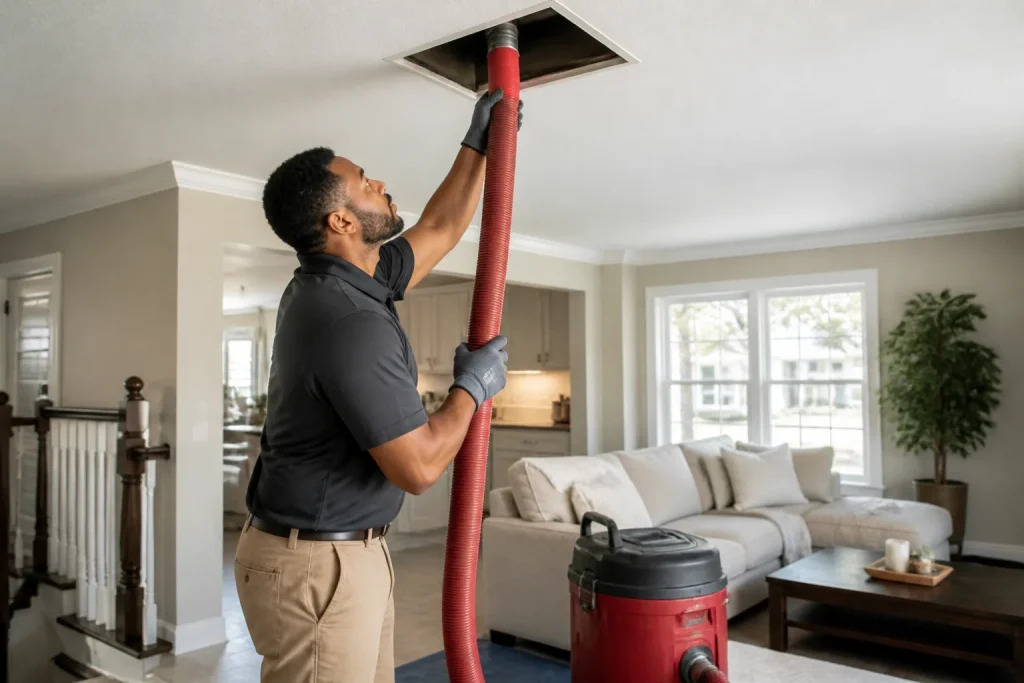
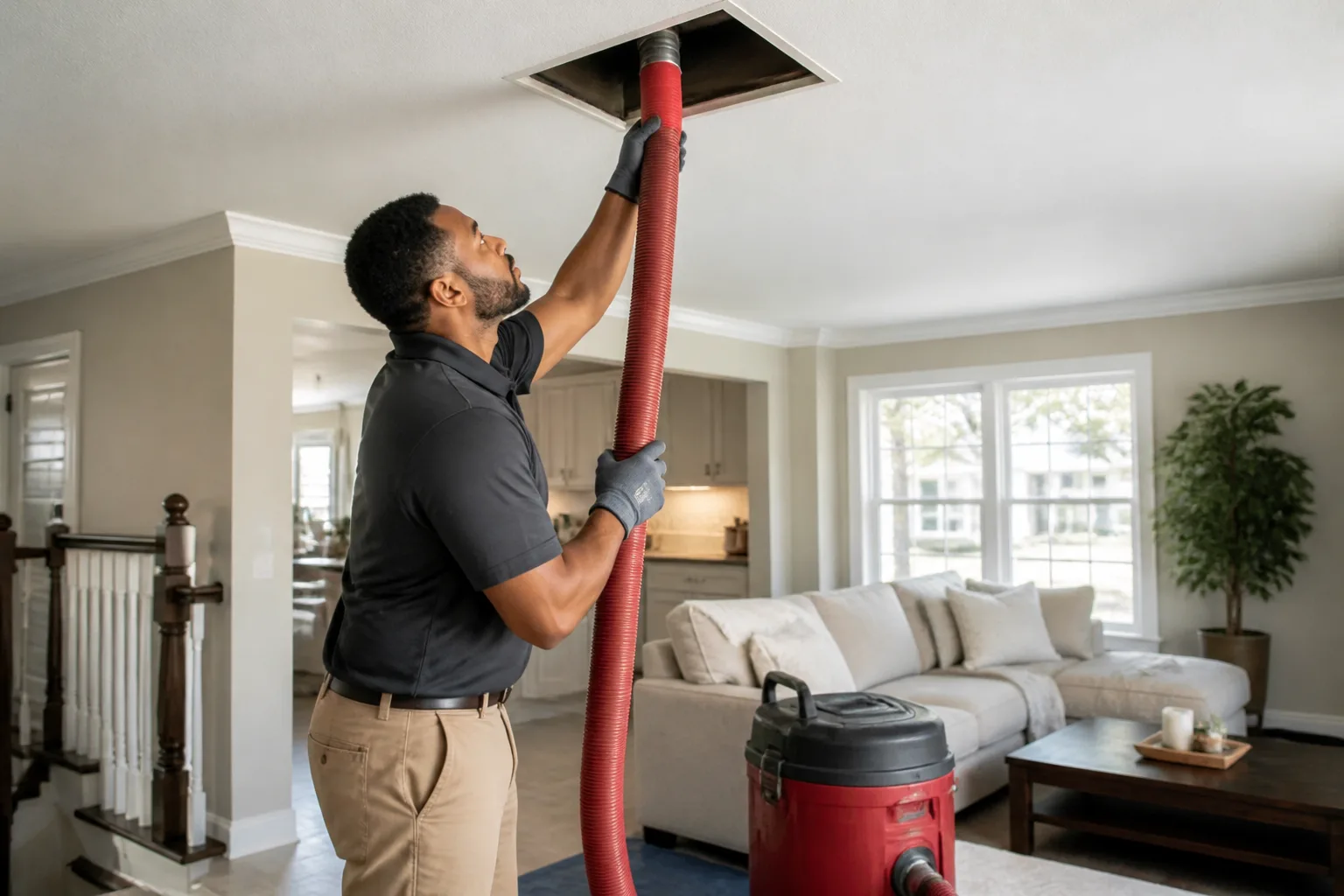
- Clean with commercial-grade equipment. This is where we use Air Duct Cleaning Williamsbridge systems from Rotobrush and Nikro, the same class of equipment professional restoration crews work with. Consumer vacuums don’t move enough air to do this job.
- Seal. Gaps at joints and connections let conditioned air escape and unfiltered air enter. Sealing closes the pathway.
- Sanitize. Abatement Technologies equipment, the kind used in professional remediation settings, handles this step. Guardsman-grade finishing products leave the system protected, not just cleaned.
- Install or service the Honeywell equipment. Now the F300 or UV light sits in a clean, sealed pathway and can do what it was designed to do.
If you’re adding a Honeywell purifier, don’t skip steps one through four. That’s the whole point of doing this in order. This applies to the full system, and it’s why air duct cleaning is a prerequisite, not an upsell.
What Honeywell UV germicidal lights can and cannot do
A Honeywell UV germicidal light does one job well: it kills biological contaminants at the cooling coil. That matters. The coil is damp, dark, and just warm enough to be a growth surface, and UV light aimed at it keeps that growth in check.
What it doesn’t do is just as important to understand. It does not:
- Remove settled debris from branch ducts. UV light shines on surfaces it can see. It can’t vacuum a supply run.
- Clean the air the way a media filter or electronic air cleaner does. It’s a coil treatment, not a whole-system filter.
- Reach areas upstream or downstream of its mounting point. It treats its own immediate zone.
So a Williamsbridge home with a UV light and dirty branch ducts has a protected coil and contaminated branch runs. Both things are true at once. That’s why UV equipment is a layer in a full-system approach rather than a replacement for duct cleaning. When we describe our work, we call it what it is: clean it, seal it, sanitize it. The UV light is one part of a sequence, not a substitute for it.
How do you maintain Honeywell in-duct equipment between cleanings?
Maintenance is where Honeywell systems either stay effective or quietly fall off. The general rhythm most units need:
- Electronic air cleaner cells: wash the F300 collection cells on a regular cycle per the manufacturer’s instructions. Grease and dust load them faster than most people expect.
- Media filters: replace on the manufacturer’s stated interval, and sooner if you’re in a dusty area or have pets. A loaded media filter chokes airflow.
- UV bulbs: replace within the window Honeywell specifies for your model. The lamp keeps glowing after its germicidal output has faded, so a working-looking bulb isn’t proof of a working bulb.
- TrueSTEAM humidifiers: follow the service schedule for the unit and watch for mineral buildup, which is the usual reason performance drifts.
- Duct cleaning: schedule it alongside the equipment maintenance rather than as a separate emergency. The two reinforce each other.
A quick word on that last point. Most homes don’t need duct cleaning on a strict calendar. They need it when conditions call for it: visible debris, a recent renovation, persistent dust, or a system that isn’t keeping up. If you’re not sure, an inspection answers the question faster than a guess does.
Why homeowners in Williamsbridge should ask for pressure and airflow checks
This is the step a lot of duct cleaning stops short of, and it matters most when Honeywell equipment is in the system. A Honeywell air cleaner or UV light is engineered to perform to a manufacturer spec that assumes a certain airflow and static pressure. If the duct pathway is restricted, undersized at a run, or leaking, the equipment may test fine on a bench and underperform in the house.
So during service, ask for duct pressure and airflow checks, not just a visual “looks clean” confirmation. The checks show whether the system is actually moving the volume of air the equipment expects. In Williamsbridge houses where the HVAC has been added to, rerouted, or closed off over the years, those measurements are the difference between a clean-looking system and a working one.
We think of it this way: our technicians have up to 13 years of experience, and the thing you learn fastest on this side of the work is that clean and correct aren’t always the same. If the numbers don’t line up, the fix might be sealing rather than more cleaning. That’s why we treat HVAC cleaning and duct repair as part of the same conversation rather than separate jobs.
When to call a pro
Some things are worth checking yourself. Some aren’t. Call a professional when you notice:
- Visible dust or debris when you open a supply register or look into the return.
- Recurring dust on surfaces shortly after cleaning, suggesting the system is redistributing it.
- A musty smell when the blower runs.
- A new Honeywell unit installed before any duct assessment was done.
- A clogged dryer vent. This is one of the leading causes of residential fires, and it’s a safety issue, not a housekeeping one. A blocked vent traps heat and lint in a place built to move both out. That’s the call that shouldn’t wait. You can read more about our dryer vent cleaning as part of the same full-system approach.
For anything involving the HVAC electrical side, including wiring a Honeywell air cleaner or replacing a UV lamp in a hard-wired fixture, leave it to a trained professional. Panels and wiring are genuinely dangerous, and a wrong connection is worse than a delayed install.
The Bottom Line
Honeywell builds good equipment. It just can’t rise above the system it’s installed in. The order of operations that makes sense in Williamsbridge homes is: inspect, clean, seal, sanitize, then install or maintain the Honeywell gear, and check airflow and pressure so the equipment actually meets spec. Maintenance after that is a simple rhythm of cells, filters, and bulbs on the manufacturer’s schedule.
If you’re in Williamsbridge and need help sorting out whether your ducts are ready for the equipment you’ve got or plan to add, Air Duct Cleaning Williamsbridge offers free estimates. We use Rotobrush and Nikro for the heavy lifting, Abatement Technologies for sanitizing, and Guardsman-grade products to finish. One team, one visit, the whole air pathway. Call (844) 443-3861. We answer 24/7. Fast dispatch from 7am to 7pm, Sunday through Friday.
Frequently Asked Questions
You can, but you shouldn’t. Installing an in-duct Honeywell purifier before cleaning means the new equipment draws contaminated air from day one, coating new cells and lamp housings with debris. Clean, seal, then install. For an exact quote on a full pathway service, call (844) 443-3861 – estimates are free.
No. A Honeywell UV germicidal light kills biological contaminants at the cooling coil, but it doesn’t remove debris from branch ducts or filter the whole airstream. It works alongside duct cleaning, not instead of it. Call (844) 443-3861 to schedule an assessment – estimates are free.
Follow the interval Honeywell specifies for your model, and clean sooner in a dusty home or one with pets. Loaded cells lose collecting power quickly. If you can’t remember the last cleaning, that’s your answer. Call (844) 443-3861 for a duct inspection – estimates are free.
Cheap quotes usually skip steps, whether that’s proper pressure and airflow checks or commercial-grade equipment. The low price is often just the entry point. We set one flat price per system, agreed in writing before work starts, and provide before-and-after photos of your own ducts so you can see what changed. Call (844) 443-3861 for a written estimate – estimates are free.
Written by the team at Air Duct Cleaning Williamsbridge.
Need Air Duct Cleaning Help?
Call Air Duct Cleaning Williamsbridge - the local pro we connect you with is licensed and insured, with free written estimates in Williamsbridge.
(844) 443-3861